Institut für Linguistik
Goethe-Universität Frankfurt


Welcome
Welcome to the Institute of Linguistics! On this website you can find all the important information about the institute.
ViCom at the Frankfurt Science Festival
On 19 September, ViCom will be at the Frankfurt Science Festival at the Roßmarkt with two interactive stations on visual and multimodal communication. Read more.
|
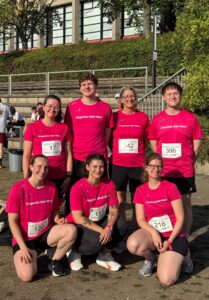
The Linguistic Owl-Stars at the Goethe Run Seven members of the Institute of Linguistics took part in this year’s Goethe Run as the Linguistic Owl-Stars. Read more. |
 |
|
Proceedings der Sinn und Bedeutung (SuB) 30 We are delighted to announce that the Proceedings of Sinn und Bedeutung (SuB) 30, which took place in Frankfurt in September 2025, have now been published! The volume, featuring the wonderful contributions presented at SuB30, is available here. |
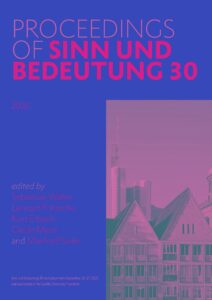
The cover was designed by Daniel Gutzmann and features a photograph by Alex Lowles (@alexlowlesphotography). |
“Questions? Answers! And more” Workshop
We are happy to announce a student workshop with four talks and five posters, as part of the MA seminar „Questions and Answers“ by Prof. Katharina Hartmann. You can find the program here.
Workshop title: Questions? Answers! And more
Date: Monday, 06th July 2026
Time: 14:00h – 17:35h (s. t.)
Room: IG 4.301 (linguistics room)
Corinna Langer and Anna Pressler successfully defend their dissertations
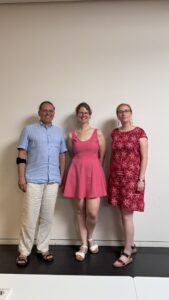 |
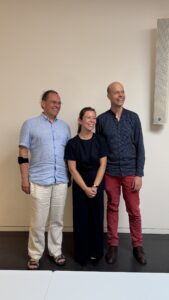
On June 26, 2026, two dissertation defenses were successfully held in the Phonology group. Corinna Langer defended her thesis entitled Focus and Prosody in Hungarian – investigating syntactically unmarked focus in the morning and Anna Pressler defended her thesis on Prosodic factors at the phrase level: the positioning of French adjectives in the afternoon. We warmly congratulate both for their achievement! Read more. |
 |
Sebastian Walter successfully defends his dissertation 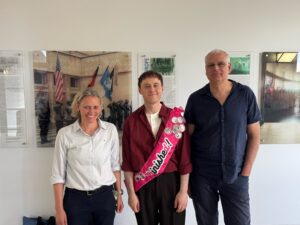
On June 8, 2026, Sebastian Walter successfully defended his dissertation titled Interactions of perspective-taking in gesture and speech. We warmly congratulate him on this achievement! Read more.
Proceedings of GLOW 47
We are pleased to announce that the proceedings of GLOW 47, which took place in Frankfurt in March 2025, have been published. The current issue can be found here.
Dissertation by Sebastian Bredemann Published
We are pleased to announce that the dissertation titled “The role of phonology at spell-out” by Sebastian Bredemann has been published via the University Library Frankfurt (UB Frankfurt):
https://publikationen.ub.uni-frankfurt.de/frontdoor/index/index/docId/96769
We warmly congratulate him on the successful completion of his PhD!
Potential Field Multimodal Communication
In January 2026, the Potential Field Multimodal Communication (speakers: Cornelia Ebert, Frank Kügler) has started at Goethe University Frankfurt. The research focus aims to bring together scholars from linguistics, literary and cultural studies, theatre and performance studies, film and media studies, psychology, neurocognition, musicology, and computer science.
New DFG Collaboartive Research Centre
In October 2025, the new DFG Collaborative Research Centre Common Ground (CRC 1718) starts at the University of Tübingen. We are delighted that the Institute of Linguistics will be participating with the project Multimodality, Iconicity, and Common Ground: On the Status of Spoken Language and Gesture. (PIs: Kathryn Barnes, Cornelia Ebert & Britta Stolterfoht).

Sinn und Bedeutung 30 (SuB30) 2025 in Frankfurt 
The 30th edition of Sinn und Bedeutung (SuB30) will take place at Goethe University Frankfurt from September 23–27, 2025, organized by the Semantics professorship.
The conference will feature:
- a three-day main session (September 24–26)
- two one-day special sessions:
For more information please visit https://vicom.info/sub30/.
Best student presentation of MMSYM 2024 is from Frankfurt
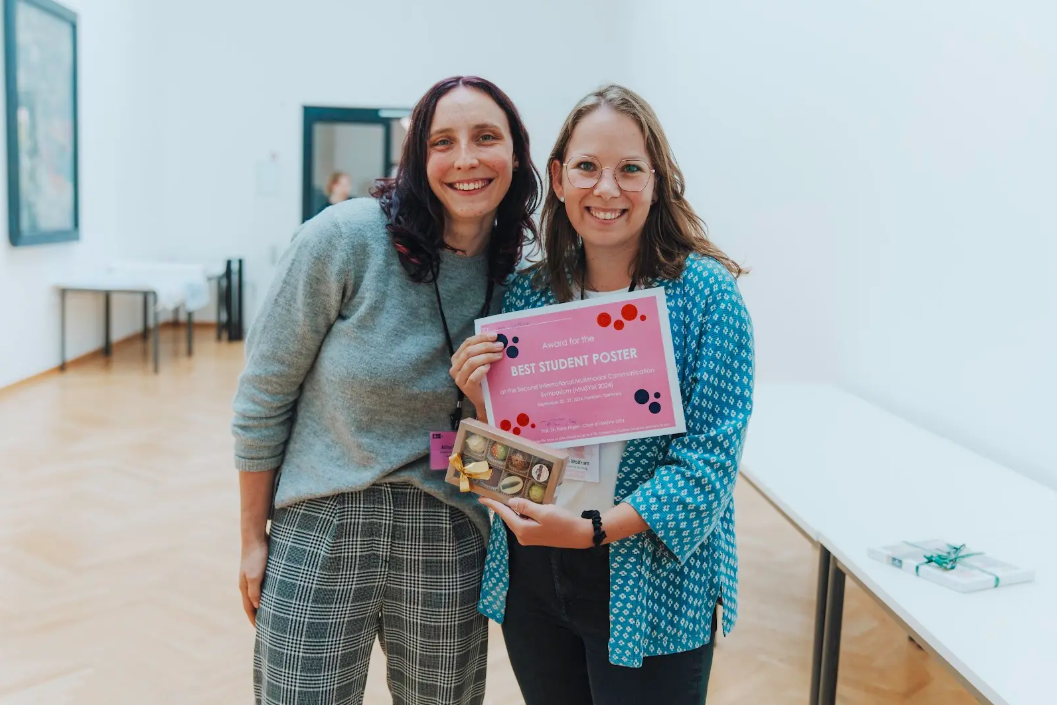
Employee and doctoral student Alina Gregori as well as Vera Wolfrum (Uni Würzburg) win the award for the best student presentation at this year’s MMSYM.
Best student presentation of Speech-Prosody 2024 is from Frankfurt
Employee and doctoral student Anna Preßler wins the award for the best student presentation at this year’s Speech-Prosody Conference.
Jacob and Wilhelm Grimm Prizes for International German Studies awarded to Ermenegildo Bidese
Ermenegildo Bidese (University of Trento) completed his habilitation in the Department of Modern Philology in Frankfurt in 2021. In 2024 he received the Jacob and Wilhelm Grimm Prizes for International German Studies from the DAAD.
End of Seminars = Start of Term Papers
With the conclusion of the lecture period, the work on the term papers begins. We kindly request all students writing term papers or theses in linguistics to follow our guidelines.
We celebrate Katharina Hartmann’s 60th birthday
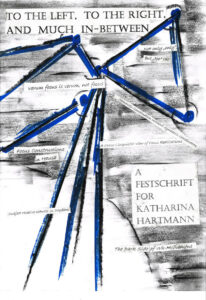
During the birthday workshop “Syntax in Focus – A workshop in honour of Katharina Hartmann’s 60th birthday” we presented the festschrift in honour of Katharina on January 12, 2024: “To the left, to the right, and much in between“. It can be downloaded for free as an e-book (PDF) here.
We congratulate the Institute of Linguistics on the newly approved special research area NegLaB
From April 2024, the new DFG special research area “Negation in Language and Beyond” (SFB 1629 NegLaB) will start at Goethe University. The Institute of Linguistics is significantly involved in numerous projects at the SFB.
MA student Farbod Eslami Khouzani receives this year’s DAAD Prize
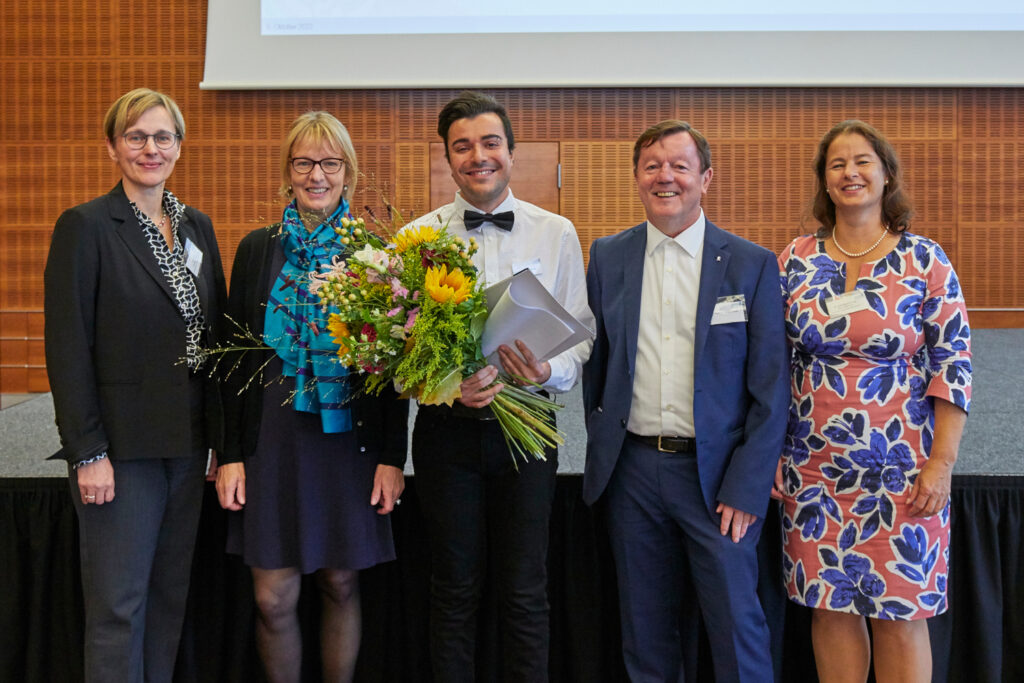
The MA linguistics student Farbod Eslami Khouzani (picture, middle) received this year’s DAAD Prize for international students on October 5th, 2023. His outstanding academic achievements as well as his social commitment were recognized. We congratulate him! More information
Prof. Katharina Hartmann and Prof. Frank Kügler nominated for the best doctoral supervision
The Goethe Research Academy for Early Career Researchers (GRADE) awards a prize every year for the best doctoral supervision. This year, two of the professors from linguistics have been nominated: Prof. Frank Kügler and Prof. Katharina Hartmann. More information
Information for freshman/beginners
- Paper work that cannot be done by e-mail can be deposited in the mail box “Hauspostfach 2” at the central mailroom (IG 257).
- Important websites with current information:
- Information about exams (no „Staatsexamen“):
https://www.pgks.de/
https://www.uni-frankfurt.de/73862497/ZPL___Aktuelles - Information for teachers (ABL):
https://lehrkraefteakademie.hessen.de/lehrerausbildung/pruefungsstellen/frankfurt-am-main/aktuelle-infos
- Information about exams (no „Staatsexamen“):
Studies
The Department of Linguistics at Goethe University Frankfurt offers in collaboration with the Department of English and American Studies, the Department of Psycholinguistics and the Teaching of German, and the Department of Romance Literatures and Languages two linguistic programs, a BA Linguistik taught in German and an MA Linguistics taught in English. In addition, the Department takes part in the BA Germanistik and in the Teacher Education Program.
Further information:
Research
Overview about the research at the institute
 |
|
 |

The Institute of Linguistics, which is based in the Faculty of Modern Languages (FB 10), has special expertise in the fields of language structure (syntax and phonology), semantics and pragmatics, psycholinguistics (language acquisition, language processing), and historical linguistics, and represents known researchers. In addition, there are close contacts and cooperation with the linguists in the Institutes of English and Romance Studies, with philosophy (Faculty of Philosophy and History, FB 08), and the Institute for Empirical Linguistics (Faculty ofLinguistics and Cultural Studies, FB 09).
Besides the Institute of Linguistics, there is also research and teaching in linguistics in other institutes. More details can be found here:
- Institute of English and American Studies
- Institute of Psycholinguistics and Didactics of the German Language
- Institute of Romance Languages and Literatures
- Institute of Empirical Linguistics
The potential of the Frankfurt linguistics is especially in the realm of foundational research in linguistics. The active research is bundled in various projects.
Institute
The following professorships belong to the Department of Linguistics:
- Professur Historische Linguistik (Weiß)
- Professur Phonologie (Kügler)
- Professur Psycholinguistik (Bader)
- Professur Semantik (Ebert)
- Professur Syntax (Hartmann)
In teaching, the following professorships are affiliated to the Institute of Linguistics:
- Professur für die Didaktik der deutschen Sprache (Grimm, kooptiert)
- Professur für Philosophie (Fuhrmann, kooptiert)
- Professur für Spracherwerb (Schulz, kooptiert)
Carolin Reinert at SALT 36 in Buenos Aires
From July 29-31, 2026, Carolin Reinert attended the 36th Semantics and Linguistic Theory (SALT) conference at the University of Buenos Aires, Argentina, where she presented a joint poster with her co-author Carla Spellerberg (University of Massachusetts Amherst).


The poster, entitled “Telling World Knowledge and Linguistic Knowledge Apart: Experimental Evidence for a Meaning-Based Perspective on Nominal Event Arguments”, presented new experimental evidence on how lexical meaning and world knowledge interact in the interpretation of adjective-noun combinations. Combining theoretical semantics with psycholinguistic experimentation, the project investigates which nouns encode typical activities as part of their linguistic meaning. The results of a maze experiment support a meaning-based account according to which both deverbal and certain non-deverbal nouns are associated with event arguments, contributing to our understanding of how linguistic knowledge differs from general conceptual knowledge.
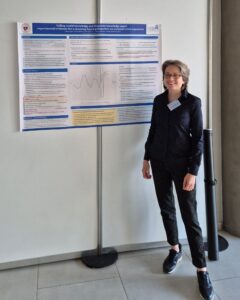
The conference offered an inspiring environment for scientific exchange, with talks and poster sessions covering a wide range of topics in formal semantics. Presenting the poster sparked engaging discussions with researchers from different theoretical backgrounds, providing valuable feedback and new perspectives for the ongoing development of the project. Beyond the scientific program, the conference also provided opportunities to experience the local culture. The conference dinner featured live tango music and dancing, offering participants a memorable evening and a chance to continue conversations with colleagues in a uniquely Argentine setting.
Overall, SALT 36 was an excellent opportunity to present ongoing research, strengthen international connections within the semantics community, and gain fresh inspiration for future work.
Talk by Pascal Hohmann (Frankfurt) in the Semantics Colloquium
We are happy to announce a talk by Pascal Hohmann (Frankfurt) in the Semantics Colloquium.
The talk will take place on campus in IG 4.301.
Date: July 16, 2026
Time: 4 pm – 6 pm c.t.
Title: Before what happens? NPIs and expletive negation in German bevor-clauses
Abstract:
German ‘bevor’ (‘before’) clauses are an unusual environment in which two superficially opposite, negation-related phenomena surface in one and the same syntactic frame. On the one hand, ‘bevor’-clauses license negative polarity items (NPIs) — such as ‘mit der Wimper zucken’ ‘bat an eyelid’, ‘(einen) Mucks machen’ ‘make a peep’, ‘ein Wort sagen’ ‘say a word’, or ‘je’ ‘ever’. On the other hand, they host expletive negation (EN): a ‘nicht’ that, in the right context, does not reverse the truth conditions of the clause it appears in (Krifka 2010):
(1)
Ich gehe nicht nach Hause, bevor das (nicht) fertig ist.
‘I won’t go home before that is (not) finished.’ — both variants truth-conditionally equivalent
The talk pursues a semantic question: are NPI licensing and expletive negation freely available inside ‘bevor’-clauses, or are they conditioned — and if so, by what?
The point of departure is Tahar’s (2021) typology of before-clauses, which distinguishes three uses: consecutive (a factual temporal sequence), apprehensive (preventive; the main clause aims at avoiding the before-event — a negative purpose), and frustrative (the main clause is an ‘active inaction’ motivated by the expectation that the before-event will not occur — a negative reason). The hypothesis under investigation is that the two phenomena stand in complementary distribution along this divide: NPIs surface in apprehensive (and consecutive) ‘bevor’, expletive negation only in frustrative ‘bevor’:
(2)
a. Noch bevor die Frau einen Mucks machen konnte, hielt ihr der Fremde den Mund zu. (apprehensive; NPI)
b. Kein Spieler darf zwei Elfmeter ausführen, bevor (nicht) alle anderen Mitspieler geschossen haben! (frustrative; EN)
Empirically, I test the hypothesis on web-scale corpus data (deTenTen23, 1.17B sentences; ~2.25M ‘bevor’ tokens), extracting NPI and EN candidates and classifying random samples of 100 hits each by Tahar’s diagnostics. The data support the complementary distribution: EN occurs exclusively in frustrative contexts, and NPIs are absent from frustrative ones. At the same time, a robust consecutive/apprehensive ambiguity in the NPI data indicates that the three-way typology is under-determined for German.
Theoretically, the result sharpens a puzzle for the existing accounts: if EN is licensed by matrix negation together with a semantically uniform ‘bevor’, why is it barred from consecutive ‘bevor’ even when the main clause is negated?
Talk by Chiara Marchetiello (Dublin) in a joint session of the Semantics and Syntax Colloquia
We are happy to announce a joint session of the Semantics and Syntax Colloquia, featuring a talk by Chiara Marchetiello (Dublin).
The talk will take place on campus in IG 411.
If you wish to participate virtually via Zoom, please contact Lennart Fritzsche for the link.
Date: July 9, 2026
Time: 4 pm – 6 pm c.t.
Title: To be or not to be integrated: A formal account on [PDO] in Campania
Abstract:
In this talk, I discuss some initial observations on the syntactic integration of gesture found in the rich gestural inventories of the local languages spoken in Campania region (Italy). Specifically, I present two case studies on the gesture called [PALM-DOWN-OPEN-HAND-PRONE] ([PDO]). Based on new data collected from primary fieldwork I conducted in Campania, I show that [PDO] can be syntactically integrated into the grammar of the languages of Campania in two different ways. When [PDO] accompanies speech, it can be interpreted as an epistemic marker which indicates the speaker’s certainty towards the truth-value conditions of the content of the spoken utterance it accompanies. Conversely, when [PDO] is used in place of speech, it can be considered as a negative response marker like English ‘no’. Crucially, this study provides evidence in support of the Grammatical Integration Hypothesis (Colasanti 2023a,b), which hypothesis that (at least) some gestures can be integrated into the grammar as morphemes externalised at the Phonological Form (PF) in the visual-gestural modality as gesture, rather than in the auditory-spoken modality as speech.
Talks by Prince Asiedu (Frankfurt) and Jan Köpping (Frankfurt) in the Semantics Colloquium
We are happy to announce a talk by Prince Asiedu (Frankfurt) and a talk by Jan Köpping (Frankfurt) in the Semantics Colloquium.
The talks will take place on campus in IG 4.301.
If you wish to participate virtually via Zoom, please contact Lennart Fritzsche for the link.
Date: July 2, 2026
Time: 4 pm – 7 pm c.t. (the two talks will be given consecutively within an extended colloquium slot.)
Prince Asiedu (Frankfurt)
Title: Multimodal iconicity of ideophones and Co-speech gestures in Akan
Abstract:
Many spoken languages with diverse typological features have ideophones, a special class of words defined as “an open lexical class of marked words that depict sensory imagery” (Dingemanse 2019). Ideophones share certain morphological and semantic properties (Kita 1997, Dingemanse 2015, Barnes 2024, Ebert and Steinbach 2024). They are an open lexical class. They depict rather than describe. There is an iconic relationship between form and meaning. They are marked expressions with specific grammatical properties, such as reduplication. They lie in the domain of sensory imagery. Ideophones are often accompanied by a conventionalised co-speech gesture. In this presentation, I focus on the last property. I investigate the formal properties of ideophone-accompanying gestures in Akan (a Kwa language spoken in Ghana). I ask how gestures visually depict the meaning of the ideophone, and how the degree of conventionalisation influences the multimodal production of ideophones and co-speech gestures. Generally, I hypothesise that a gesture will depict the meaning of an ideophone, and that highly conventionalised ideophones will be accompanied by more consistent, similar gesture patterns across speakers. 10 Akan native speakers (5 older than 40 years, 5 younger than 40 years) were asked to produce a gesture that accompanies the 12 ideophones they heard, without any contextual information. All items were presented to the speakers on PowerPoint. Participants listened to two audio files: one containing the ideophone and the other containing a question. For the accompanying gestures, I used phonological similarity as a measure of their conventionalisation grade: the more similar the gestures produced by different speakers for the same ideophone, the more conventionalised we considered them. Phonological similarity was measured by comparing the specification of all relevant phonological parameters (handedness, movement, handshape, orientation, location). The evaluation of the data shows that 9 out of 10 ideophones accompanied by a gesture in Akan appear to be similar across speakers, indicating a high degree of conventionalisation. The data shows that the phonological structure of the ideophone aligns with the gesture (reduplicated ideophones have corresponding reduplication of the gesture).
Jan Köpping (Frankfurt)
Title: “The” universal falsifier
Abstract:
In a recent paper (Hofmann 2025), Lisa Hofmann introduced a “universal falsifier” into the domain of individuals over which assignment functions range in dynamic semantics to account for the (somewhat surprising) projection behavior of discourse referents that are introduced by indefinite descriptions embedded below negation. Her proposal is in a nutshell, that their falsity conditions make use of this peculiar individual to “use up” the discourse referent they introduce without being able to assign to it a proper individual as value. This then allows for anaphora in certain cases, even though the antecedent traditionally is conceived to be inaccessible. My talk intends to explore several ways how this idea can be transferred to the semantics of definite descriptions and discusses their consequences.
Corinna Langer and Anna Pressler successfully defend their dissertations
On June 26, 2026, two dissertation defenses were successfully held in the Phonology group.
Corinna Langer defended her thesis entitled Focus and Prosody in Hungarian – investigating syntactically unmarked focus in the morning and Anna Pressler defended her thesis on Prosodic factors at the phrase level: the positioning of French adjectives in the afternoon.
We warmly congratulate both for their achievement!
Corinna Langers dissertation investigated two cases of focus marking in Hungarian where syntax cannot disambiguate the scope of focus. Using a combination of production and perception experiments, she finds that prosody does disambiguate focus scope in Hungarian contexts where syntax does not do so. She discusses her findings in light of existing syntax-prosody mapping approaches.
Anna Presslers dissertation investigated the positioning of a set of french adjectives (pre- or postnominal) that do not have a syntactical or semantic preference for any position. In four empirical studies, she explored the influence of prosodic factors relative length and rhythmic alternation, which she found to influence the adjective position. She proposes requirements for a speech model that captures the variability in the positioning of these adjectives.