Approaches to NPIs and their Licensing Conditions: Anything New? (Working group at DGfS 2026)
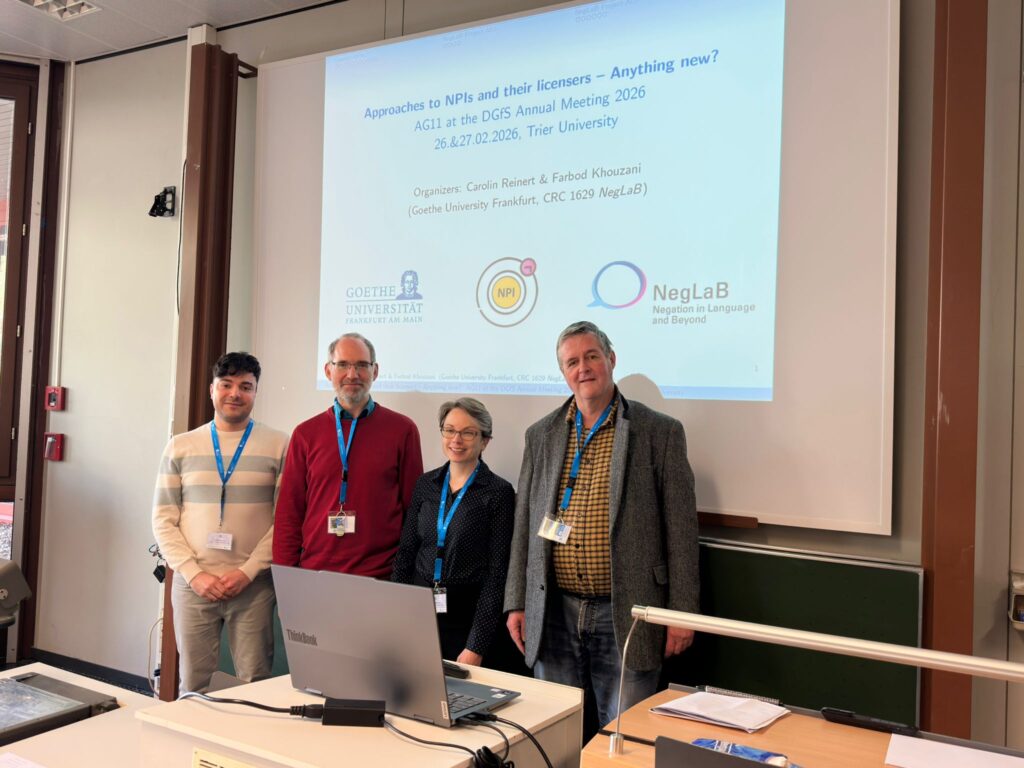
Organized by Carolin Reinert & Farbod Khouzani (Goethe-Universität Frankfurt, CRC NegLaB)
On 26 and 27 February 2026, the workshop Approaches to NPIs and their Licensing Conditions: Anything New? took place as part of the 48th Annual Conference of the German Linguistic Society (DGfS 2026). The workshop brought together researchers working on negative polarity items (NPIs) from theoretical, experimental, corpus-based, and cross-linguistic perspectives, with the goal of reassessing classic questions about NPI licensing in light of recent developments.
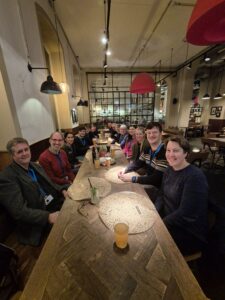
We kicked off the workshop with a stimulating Warming Up Dinner on the evening of 25 February, which gave us the occasion to get to know each other and start exchanging our ideas on NPIs.
Invited Talks
We had the pleasure and honor to welcome two wonderful invited speakers to our workshop.
Our first invited speaker Manfred Sailer (Goethe-Universität Frankfurt) presented corpus-based work on The NPI that licensed itself, offering fine-grained corpus profiles that challenge overly rigid licensing diagnostics and highlight the importance of usage-based evidence in polarity research.
Our second invited speaker Jack Hoeksema (Rijksuniversiteit Groningen) concluded the workshop with his talk about Paradigmatic and syntagmatic factors in the licensing of polarity items, which presented a broad comparative perspective on the different factors in NPI licensing.
Contributed Talks
The contributed talks reflected the diversity and vitality of current NPI research:
- Kazuhiko Fukushima (University of Air) and Kentaro Nakatani (Konan University) examined Japanese –sika, arguing that its behavior complicates traditional licensor-based models and invites the consideration of individual lexical properties of NPIs.
- Leah Doroski (Universität Konstanz) addressed polarity sensitivity in attitude predicates, focusing on hope and its implications for the semantics-pragmatics interface.
- Chiara Marchetiello (Trinity College Dublin) explored the parasitic licensing conditions of a gestural NPI (the chin flick gesture), extending polarity research into the multimodal domain.
- Stephanie Solt and Andreea C. Nicolae (ZAS) proposed a simplicity-based account of high-degree NPIs, arguing for a novel source of polarity sensitivity (underspecified semantics coupled with simplicity-based competition).
- Anna Czypionka, Doris Penka, and Maribel Romero (Universität Konstanz/Universität Fribourg/Universität Tübingen) presented ERP evidence on emotive predicates in German, offering experimental insight into processing differences across licensing environments.
 |
Concluding Remarks We thank all speakers and participants for two days of stimulating discussion and look forward to continued collaboration on polarity phenomena. |